Best Online Craps Casinos in Australia
 Available in US
Understand the table, core bets, live and electronic formats, and the rules that shape craps outcomes.

Table of Contents
- What Casino Craps Is and How the Game Works
- Casino Craps Terminology and Core Rules
- How to Assess Online Casinos for Craps in Australia
- The Craps Table Layout, Bets, and Bonus Terms
- Real-Money Craps, Electronic Tables, and Bubble Craps
- How to Play Craps Online and Place the Main Bets
- How to Play Craps at a Casino
- What Live-Dealer Craps Adds to the Online Format
- Winning at Craps: Probability, Variance, and Bankroll Limits
- Crapless Craps and Its Rule Differences
What Casino Craps Is and How the Game Works
Craps is a casino dice game built around repeated rolls of two dice. Its structure is communal: one person rolls, while other players place wagers on possible outcomes and the casino supervises the table. The dice are ordinary physical objects in a traditional game, but the surrounding table, dealer positions, and marked betting areas give the game its distinctive organisation.
A round does not consist of one isolated roll. It develops through a sequence that begins with a new shooter and a come-out roll, may continue through several rolls while a point remains active, and ends when a defined result closes that cycle. The next cycle then begins, either with the same shooter or with another person according to the table’s procedure.
The role of the dice
Two dice determine every result in standard casino craps. Each die has six faces, so a roll produces a combined total formed by adding the visible faces. The possible totals range from the lowest combined result to the highest, with some totals more likely than others because different dice combinations can produce them.

The dice do not possess memory. A previous result does not alter the mathematical possibilities of the next roll, and a sequence of repeated totals does not establish a trend that can be relied upon. This principle is important when considering craps odds or any proposed casino craps strategy: observations from a short sequence cannot change the underlying structure of the game.
At a physical table, the shooter generally rolls both dice together so that they travel across the table and reach the far end. The table design helps make the result visible to the participants and reduces ambiguity about which roll counts. The dealers monitor the dice, announce the outcome, and manage the wagers associated with the current stage of the round.
The table as the game’s framework
A craps table is more than a surface on which dice are thrown. Its printed sections represent different possible relationships between the current roll, the beginning of a round, and the continuation of an established sequence. Some areas concern the initial roll, while others become relevant only after a point has been established. Additional sections relate to individual totals or combinations.

This arrangement allows many players to participate in one roll without every wager having the same conditions. A player may therefore be interested in the same dice result for a different reason from another player. The dealers place or adjust wagers in accordance with the marked layout, while the shooter’s role remains limited to rolling the dice and following the table’s physical procedure.
The visual complexity of the layout can make a casino craps game appear more difficult than it is. At a conceptual level, the central distinction is between the opening phase of a round and the later phase that follows the establishment of a point. The table’s markings express that distinction rather than creating separate games.
The main stages of a round
The first roll of a new round is called the come-out roll. It determines how the round develops. Certain results end the round immediately, while another class of result establishes a point. If a point is established, the game moves into a continuing phase.
During this phase, the shooter rolls again and the outcome is interpreted in relation to the point already recorded. The round can end when the point is repeated, or it can end through another result defined by the game’s rules. Until one of those closing conditions occurs, the point remains the reference for the sequence.
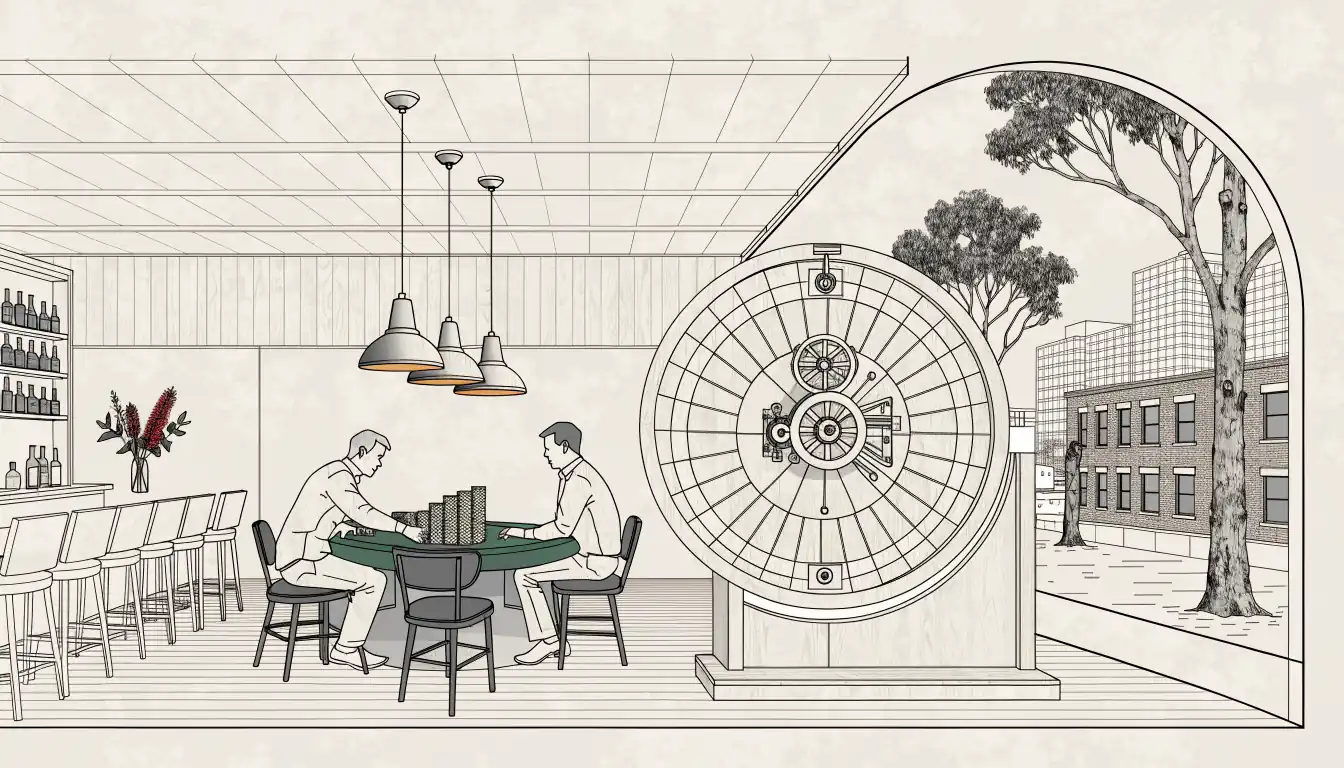
This framework explains why craps is often described as a game of stages rather than a series of unrelated dice throws. The same total can have a different significance depending on whether it appears on the come-out roll or after a point has been established. Understanding that change in context is more useful than memorising isolated craps tips.
When the active round ends, the table returns to a new come-out phase. The shooter may continue rolling, subject to the table’s procedure, or the dice may pass to another shooter. The change of shooter does not alter the mathematical properties of the dice; it changes only who physically makes the next roll.
What makes casino craps distinctive
The casino game of craps combines a simple random mechanism with a layered social format. The dice supply the outcome, the table identifies the relevant stage, and the dealers maintain the connection between the announced result and the wagers in play. Players can remain involved across multiple rolls, which gives the game a continuing rhythm absent from a single-outcome dice wager.
Game Basis Two dice rolls
Core Sequence Come-out roll and point phase
Primary Wagers Pass Line and Don’t Pass
That rhythm also explains the difference between the game’s appearance and its actual logic. A busy table may contain many simultaneous wagers and frequent dealer announcements, but the underlying sequence remains stable: a new round begins, the come-out roll determines its direction, a point may be established, and later rolls either continue or close the round.
Casino craps rules, craps odds, and any discussion of strategy should therefore be interpreted within this structure. Strategy cannot control the dice or convert an uncertain outcome into a guaranteed one. At most, it describes how a participant chooses among the available wager types and manages exposure, subjects addressed separately from the basic architecture of the game. The essential foundation is the relationship between two dice, the marked table, the shooter, and the changing stage of each round.
Casino Craps Terminology and Core Rules
Casino craps uses a specialised vocabulary to describe the dice, the current state of a round, and the relationship between a wager and the house. Understanding these terms is necessary before comparing a traditional table with an online or live casino craps interface. The terminology remains broadly consistent across formats, although the display and dealing procedure may differ.
The come-out roll and the point
A new round begins with the come-out roll. This is the first roll made before a point has been established. The result determines whether the round ends immediately or moves into its point phase.
On a standard Pass Line wager, a come-out result of seven or eleven is called a natural and wins. A result of two, three, or twelve is called craps and loses that wager. Any other box number establishes the point. The relevant number is then marked on the table, indicating the condition that must be resolved before the round can finish.

Once a point exists, the shooter continues rolling. The point is made when the same number appears again before a seven. If seven appears first, the round ends with a seven-out, and the Pass Line wager loses. The dice then move to a new come-out roll. This sequence is a rule distinction rather than a prediction about the next result: the point changes the status of the round, not the mathematical independence of the dice.
Shooter, stickperson, and boxperson
The person rolling the dice is the shooter. In a physical casino, the shooter is selected from among the players and must make the dice travel across the table and reach the far end. The shooter does not control the wagers placed by other participants.
The stickperson handles the stick used to move the dice and calls the results. The boxperson supervises the table and manages the chips in the central area. Dealers generally place and pay wagers on behalf of players. In an online casino craps interface, these roles may be represented by software, animation, or a live-dealer presentation rather than by separate visible staff.
Pass Line, Don’t Pass, and come bets
The Pass Line is the principal contract bet in standard craps. It wins on a natural during the come-out roll, loses on craps, and proceeds to the point phase when a box number is rolled. After a point has been established, the wager wins if the point is made before a seven.
The opposing wager is Don’t Pass. It generally loses on a natural, wins when craps appears on the come-out roll, and pushes when the come-out result is twelve. If a point is established, Don’t Pass wins when seven appears before the point and loses when the point is made. This push rule for twelve is a formal distinction that must be checked in the table rules.
Wins on a natural (7 or 11) during the come-out roll or if the point is made.
Wins when craps appears on the come-out roll and when a seven appears before the point.
Follows Pass Line logic but is placed after the come-out roll has occurred.
A come bet follows the same basic logic as a Pass Line wager but is placed after the come-out roll. It begins with its own come-out-style resolution: a natural wins, craps loses, and another box number becomes the wager’s individual point. A Don’t Come bet is the corresponding opposite wager. Because these bets can coexist with the table’s main point, their labels help distinguish separate contracts within the same round.
Odds and proposition terminology
When a point has been established, a player may be permitted to place odds behind a Pass Line or Come wager. Odds are additional funds tied to the established point and are paid according to the true mathematical relationship between the point number and a seven. They are not a separate random event and do not alter the dice result. The available odds limit, if any, is a table rule that belongs in the displayed terms.
The centre of a craps layout contains proposition bets, which are generally resolved on the next roll or under a stated short-term condition. Terms such as Any Craps, Any Seven, Yo, and Hardways identify particular outcome categories. A hardway occurs when a paired combination produces a number, such as two twos or two threes, rather than a different combination with the same total. These wagers have their own conditions and should not be treated as interchangeable with Pass Line or Come bets.
House edge and expected return
The house edge expresses the casino’s mathematical advantage on a wager over a sufficiently large series of identical bets. It is not a fee deducted from every individual result, nor does it determine the outcome of a single roll. A wager can win repeatedly in a short session while still carrying a house edge over the long term.

Different craps bets have different mathematical characteristics. The fact that two wagers are displayed on the same table does not mean that their expected results are equivalent. Rules concerning pushes, point resolution, odds, and the timing of settlement all affect the calculation. An online craps casino should therefore display the rules for each wager rather than rely on the general reputation of casino game craps.
Natural, craps, push, and seven-out
A natural is a come-out roll of seven or eleven for a Pass Line or Come wager. Craps refers to two, three, or twelve on the come-out roll for those wagers, subject to the specific treatment of the selected bet. A push is a tie or non-winning settlement in which the original stake is returned. The treatment of a push is not universal across every wager, so the individual rule remains decisive.
A seven-out occurs after a point has been established when seven is rolled before that point. It ends the current shooter’s sequence and returns the table to the come-out stage. The term does not mean that every seven is a seven-out: a seven on the come-out roll is a natural for Pass Line and Come wagers. The timing of the roll is therefore part of the rule definition.
These distinctions apply whether the game is presented through an online casino with craps, a computerised table, or live casino craps. The interface may simplify the language, but it should not obscure whether a roll is a come-out roll, whether a point is active, and how the selected wager is settled.
How to Assess Online Casinos for Craps in Australia
This shortlist helps Australian players assess online craps casino options by checking licensing details, bonuses, deposit requirements and payout information where available. Use each verdict as a quick reference before reviewing the operator’s current terms.
License: Curacao Gaming Control Board OGL/2023/176/0095 (Hollycorn N.V.) · Bonus: 100% up to A$10,000 + 100 free spins GoldenCrown is notable for its Curacao Gaming Control Board licence, issued to Hollycorn N.V. Its welcome offer includes 100% up to A$10,000 plus 100 free spins.
License: Curacao eGaming Licence · Min. deposit: A$10 True Blue holds a Curacao eGaming Licence and lists a minimum deposit of A$10, giving readers two clear points to check when considering the operator.
Bonus: 100% up to A$750 + 200 free spins, 35x wagering · Payout speed: crypto 30-120 minutes, fiat 24-72 hours · Min. deposit: A$30 MrPacho offers 100% up to A$750 plus 200 free spins, with 35x wagering. It also lists crypto payouts in 30–120 minutes, fiat payouts in 24–72 hours, and a minimum deposit of A$30.
License: Curacao – Antillephone N.V. (Versus Odds B.V.) · Bonus: up to EUR 2,000 across 5 deposits + 200 free spins · Min. deposit: EUR 20 Thor Casino operates under a Curacao licence associated with Antillephone N.V. and Versus Odds B.V. Its promotion offers up to EUR 2,000 across five deposits plus 200 free spins, with a EUR 20 minimum deposit.
License: Curacao eGaming Licence · Min. deposit: A$10 Aussie Play holds a Curacao eGaming Licence and lists a minimum deposit of A$10. These stated details provide a concise basis for checking the operator.
License: Curacao eGaming (Dama N.V.) · Bonus: up to A$10,000 + 180 free spins, 40x wagering JeetCity Casino is licensed by Curacao eGaming through Dama N.V. Its offer reaches up to A$10,000 plus 180 free spins and carries 40x wagering.
License: Curacao · Bonus: up to A$10,000 multi-stage + 500 free spins · Min. deposit: A$20 (POLi) Lucky Dreams lists a Curacao licence and a multi-stage bonus of up to A$10,000 with 500 free spins. The minimum deposit is A$20 when using POLi.
License: Curacao eGaming OGL/2024/923/0383 (Antillephone N.V.) · Bonus: up to A$2,000 + 100 free spins across 2 deposits · Min. deposit: A$30 WinSpirit Casino holds Curacao eGaming licence OGL/2024/923/0383, associated with Antillephone N.V. Its bonus is up to A$2,000 plus 100 free spins across two deposits, with a minimum deposit of A$30.
License: Curacao (operating since 2017) · Bonus: 250% up to A$2,000 + 50 free spins on the first of six deposits · Min. deposit: A$20 Uptown Pokies has operated under Curacao licensing since 2017. Its promotion includes 250% up to A$2,000 plus 50 free spins on the first of six deposits, with a A$20 minimum deposit.
License: Curacao · Bonus: up to A$2,000 Golden Pokies is listed with a Curacao licence and advertises a bonus of up to A$2,000. These are the main stated details available for this operator.
An editorial shortlist of online craps casinos for Australian readers must begin with a legal distinction. Online casino games, including craps, are prohibited when offered to Australian customers. No domestically licensed real-money online casino exists for Australian players, and no Australian gambling licence exists for casino games. Consequently, a page describing the best casinos for online craps Australia 2026 cannot present offshore websites as Australian-licensed providers or imply that online casino play has the same status as licensed wagering.
The lawful gambling options identified for Australia are land-based casinos, licensed bookies and lotteries. Licensed bookies may provide wagering products, but that does not make them online casinos with craps. A comparison should therefore separate casino availability from general gambling availability rather than treating every licensed gambling service as a suitable craps operator.
What a credible comparison should examine
The first criterion is whether craps is actually available in the advertised format. A site may mention casino games broadly without offering standard craps, live craps, an automated table, or any craps product at all. A responsible editorial assessment should identify the format stated by the operator and avoid inferring availability from a general casino menu. The phrase “best online casino for craps” has no useful meaning unless the underlying service can be shown to offer the game and explain its rules.
Credible Comparison Criteria A responsible assessment should identify the format stated by the operator and look for transparency regarding the company, jurisdiction, and licensing authority.
Australian readers should note that offshore licences from Malta or Curaçao do not equate to domestic regulatory protection.
The same applies to claims about the best odds in craps. Odds depend on the rules, permitted bets, table limits and the specific game presentation. A general statement that one platform has superior odds is unsupported unless the relevant conditions are disclosed and comparable. A shortlist should describe published information, not convert promotional language into a mathematical conclusion.
Transparency is a separate criterion from game availability. An operator should clearly identify the company responsible for the service, the jurisdiction connected with its licence, the applicable terms, and the method used to handle complaints. Australian readers should not mistake an offshore licence for local approval. Offshore operators commonly hold licences from Malta or Curaçao rather than an Australian casino licence, and those licences do not create Australian consumer-law protection.
The status of a licence also requires careful wording. A licence number, regulator and jurisdiction may be stated only where the operator publishes them and the relevant authority provides a way to verify the information. Public registers maintained by licensing authorities such as Malta or Curaçao can assist with checking a licence number and its status. That verification concerns the offshore regulator, however; it does not establish that the operator is licensed in Australia.
Reading a shortlist without treating it as an endorsement
A ranking of online craps casinos should be read as a comparison of disclosed features, not as a declaration that the listed services are legal Australian casinos. The distinction is particularly important where a page uses terms such as “top craps online casinos” or “live craps casinos”. Those labels may describe the content of an editorial list, but they must not imply domestic licensing, statutory protection or approval by an Australian regulator.

A transparent review should also distinguish an information service from a gambling operator. A profile review describes ROOKING as presenting itself as a legal, transparent information hub rather than as an offshore casino. That description is attributable to the cited source and should not be expanded into a general conclusion about the Australian market or about any casino provider.
Operator transparency also includes the treatment of promotions. Bonus funds are subject to wagering requirements and withdrawal caps, so promotional balances cannot be assessed as if they were unrestricted cash. Those conditions belong to the operator’s contractual terms and should be visible before a deposit decision. A comparison that highlights a bonus while omitting its wagering requirements or withdrawal caps gives an incomplete account of the offer.
Australian protection has limits
The Interactive Gambling Act 2001 makes it illegal for providers to offer some online gambling services to people in Australia. Online casino games such as craps, pokies, roulette, blackjack and live dealer tables are prohibited interactive gambling services when offered to an Australian customer. The law targets the provider rather than the player, so an Australian is not committing a crime merely by placing a bet at an offshore site. That fact does not turn an offshore casino into a lawful Australian provider.
Legal Restriction Online casino games, including craps, are prohibited interactive gambling services when offered to customers in Australia under the Interactive Gambling Act 2001.
Nor does offshore access provide Australian consumer-law recourse or statutory protections. Dispute procedures, account decisions, payment issues and withdrawal disagreements may therefore be governed by the operator’s offshore terms and the rules of its licensing jurisdiction. A careful comparison should state this limitation rather than presenting offshore licensing as an equivalent substitute for domestic regulation.
Payment information also belongs in a legal and risk assessment. Credit cards, credit-related products and cryptocurrency are banned for online wagering in Australia. Any description of payment methods should reflect that restriction and should not suggest that prohibited funding routes are an acceptable way to access online casino games.
The useful conclusion from a shortlist is therefore limited: it can show which services claim to offer craps, what licence information they disclose, and which contractual conditions require attention. It cannot establish the existence of a licensed Australian online craps casino where none exists. That boundary is essential to interpreting any list of the best online craps casinos for Australian readers.
The Craps Table Layout, Bets, and Bonus Terms
A casino craps table layout is divided into visually distinct areas, each associated with particular wagers. The central layout contains the principal even-money sections, while the side areas display proposition bets and other options. Although the exact artwork and colour scheme vary between casinos, the functional arrangement is familiar: the pass line and don’t pass areas run along the outer edge, come and don’t come sections appear inside the main field, and the centre commonly contains one-roll propositions.

The layout is not merely decorative. It indicates where a wager belongs, whether it remains active for more than one roll, and which rules govern its settlement. A bet placed in the wrong area may be rejected, interpreted as a different wager, or require correction by the dealer. Online interfaces perform the same role through labelled buttons, betting panels, and markers that show active selections.
Reading the principal betting areas
The pass line and don’t pass sections are positioned around the outer edge of the table. Their labels identify opposing outcomes and distinguish them from the come and don’t come areas located within the main betting field. Place bets, field bets, and proposition bets are generally displayed separately, allowing the layout to communicate that they do not share identical settlement conditions.
The point marker is another important visual element. When it is displayed on a numbered point, it signals a change in the table’s state. In an online game, this information may appear as a highlighted number, a puck-style indicator, or a text label. The presentation should be read together with the written rules: graphics show where a selection applies, but they do not replace the terms defining when that wager wins, loses, or remains unresolved.
The centre section usually contains one-roll propositions, including wagers connected with particular dice combinations or totals. These bets are visually prominent, but prominence does not establish value. Their rules, payout tables, and treatment of winning combinations must be checked independently rather than inferred from their position.
Why layout details matter online
A digital craps table may simplify the physical arrangement without changing the need to distinguish bet types. Some interfaces use a condensed board, expandable menus, or separate controls for odds and additional wagers. A clear interface should identify the selected area, stake, applicable payout, and whether the bet remains active after the current roll.
Bonus Terms Casino craps bonuses are promotional arrangements subject to wagering requirements and withdrawal caps, which are distinct from standard table betting rules.
The relevant craps table rules are therefore found in two places: the layout and the accompanying help or rules panel. The layout explains the practical location of a selection; the rules panel defines its operation. If the two appear inconsistent, the written terms require closer examination before play continues. Particular attention belongs to optional wagers, because similar labels can conceal materially different conditions.
Craps bonuses are separate from table bets
A craps bonus is not a special bet printed on the layout. A casino craps bonus is a promotional arrangement offered under separate contractual terms. It may be described as a deposit match, bonus balance, free-bet credit, or another incentive, but its value cannot be treated as cash until the stated conditions have been satisfied.
The central condition is the wagering requirement. Bonus funds are subject to wagering requirements, meaning that qualifying play must be completed before a withdrawal is permitted under the promotion. The relevant terms may specify which games contribute, whether bonus or deposited funds are used first, and whether certain wagers are excluded. These conditions are distinct from the settlement rules for pass line, field, or proposition bets.
Withdrawal caps are a separate limitation. Even after the wagering requirements have been met, a promotion may restrict the amount that can be withdrawn from bonus-derived funds. A casino craps bonus should therefore be assessed through its complete terms rather than by the headline amount alone.
For an online casino craps bonus, the table rules determine the outcome of each game wager, while the promotional terms govern eligibility, wagering requirements, and withdrawal caps. Confusing these two documents can make a promotional balance appear more flexible than it is. The table layout describes the game; the bonus terms describe the separate agreement attached to the offer.

Real-Money Craps, Electronic Tables, and Bubble Craps
Online craps is presented in several formats, and the differences matter because the interface determines how the game is conducted, recorded, and supervised. The main categories are real-money casino craps hosted through an online gambling service, electronic craps terminals, and bubble craps. These formats may display familiar table imagery, but they do not provide the same playing environment or the same relationship with a dealer.
Online real-money casino craps
An online real-money interface represents the game through software. Dice outcomes, table activity, bet controls, and account balances appear on screen, while the underlying game is conducted digitally rather than at a physical table. This format can be available through offshore operators, because no Australian gambling licence exists for casino games and no domestically licensed real-money online casino is available to Australian players.
The legal distinction is important. Online casino games, including craps, are prohibited interactive gambling services when offered to an Australian customer under the Interactive Gambling Act 2001. The law targets the provider rather than the individual player, but offshore services do not provide Australian consumer-law recourse or statutory protections. They are also not licensed by Australian regulators. Consequently, an interface that accepts real-money play should not be described as an Australian-licensed online casino.
The financial conditions attached to an online account are separate from the game format. Promotional balances may be subject to wagering requirements and withdrawal caps, and those conditions can affect access to winnings even when the game itself is displayed clearly. Payment restrictions also apply in the Australian online-wagering environment: credit cards, credit-related products, and cryptocurrency are banned for online wagering. These issues should therefore be assessed independently from the visual quality of the craps software.
Electronic craps
Electronic craps uses a terminal or automated table rather than a dealer-led session. The machine supplies the interface, records selections, and presents the result without requiring a human dealer to manage the table. This can create a more solitary and standardised experience, with fewer social elements than a physical or streamed table.
- Verify the operator’s jurisdiction and licence
- Check specific wagering requirements for bonuses
- Review the table rules for each specific wager type
- Assume offshore licences provide Australian legal protection
- Treat promotional balances as unrestricted cash
- Assume all automated formats are regulated in Australia
The presence of animated dice or a digital table does not establish that the product is regulated in Australia. Electronic presentation describes how the game operates, not whether the operator has a lawful local licence. It also does not turn an offshore casino into an Australian-licensed service. The relevant questions remain the operator’s jurisdiction, the applicable terms, and the absence of Australian statutory protection.
Bubble craps
Bubble craps is an automated form in which the dice are enclosed in a transparent bubble or represented through a comparable machine-based process. Players interact with a screen while the device determines and displays the roll. The format is therefore closer to electronic craps than to a dealer-run table, even when the layout uses the same familiar visual conventions.
For comparison purposes, bubble craps should be treated as a distinct presentation rather than as evidence of a different legal status. Automation may change the pace, atmosphere, and degree of interaction, but it does not remove the financial risks of real-money gambling or create a domestic licence where none exists. Past outcomes likewise provide no basis for treating any automated format as a reliable means of making money or recovering losses.
How to Play Craps Online and Place the Main Bets
Online craps follows the same basic sequence as a physical table, but the betting panel replaces hand signals and dealer instructions. Before entering a round, the player selects the stake, reviews the available betting areas, and waits for the table to accept bets. In a live-dealer game, the interface also indicates when betting is open or closed. An automated table presents the same decisions through on-screen controls.
Joining a round
The practical sequence is:
- Select an available craps table and choose the stake for the round.
- Place a bet before the come-out roll while the betting phase is open.
- Wait for the dice result, which may be generated by a live shooter or by an electronic system.
- Check whether the result is a come-out outcome or a point outcome.
- Add, remove, or leave bets in place only during the periods permitted by the interface.
- Confirm the displayed stake and potential return before the next roll.
The pass line is the simplest starting point for learning how to play casino craps. It is placed before the come-out roll. If the come-out result is a natural, the pass line wins; if it is a craps result, the bet loses. If another number becomes the point, the pass line remains active while the round continues. The relevant result is then whether the point is made before a seven appears.
Following the point
Once a point has been established, the table display normally marks it clearly. The pass line cannot be treated as a new come-out bet until the current round ends. This distinction matters because the same dice result can have a different role before and after a point is established.
A player deciding how to bet on craps may add an odds bet behind the pass line after the point appears, where the particular table permits it. The odds portion is separate from the original pass line wager and follows the point until the round is resolved. The interface should show whether the bet is available, active, or locked.
The come bet works in a similar operational manner but is placed after a point has already been established. A new come bet has its own first result: a natural wins, a craps result loses, and another number becomes a separate come point. Any further action should be checked against the individual bet marker rather than inferred from the main table point.
Joining a Round
- Select an available craps table and your preferred stake
- Place bets while the betting phase is still open
- Confirm the displayed stake and potential return
- Verify if the roll is a come-out or a point outcome
Removing or changing bets
Online controls may include options such as “take down”, “remove”, or “repeat”. These functions are not interchangeable. A bet may be removable only during a permitted phase, while a place bet can have different controls from a pass line or come bet. If the interface does not allow a change, the restriction is part of that table’s rules.
The safest operational method is to confirm each wager in the bet summary before rolling. This avoids confusing the table point with a come point and prevents an unintended repeat of the previous stake. As with other casino games, a winning result is not a reliable way to recover losses; each round should be treated as a separate wager.
How to Play Craps at a Casino
A physical craps table operates through dealers, chips, and spoken or hand-placed instructions. In Australia, land-based casinos are among the legal gambling options mentioned alongside licensed bookies and lotteries. The procedure is therefore different from using an online interface and depends on the casino’s table rules and staff instructions.
Approaching the Table
The table may be busy, so observing a round before joining is acceptable. A player normally waits for a suitable pause, then approaches the rail without reaching across active players. Cash is not placed directly on the layout. It is exchanged for casino chips through the dealer, generally by placing the money on the table and stating the desired denomination. The dealer counts the cash and pushes the chips forward.
Chips should remain visible and separate from personal cash. When changing denominations, the request is made to the dealer rather than handled independently at the table.
Placing Bets
Bets are placed either by positioning chips in the relevant area or by stating the wager clearly to a dealer. The dealer confirms or moves the chips into place. Players should avoid touching chips once the dice are in motion or while the table is active. Bets that require dealer placement should be requested before the next roll, because timing can affect whether they are accepted.

The shooter receives the dice from the stickperson and rolls them toward the opposite end of the table. Other participants do not handle the dice unless selected to shoot.
Table Etiquette
Quiet attention helps prevent misunderstandings. Chips should not be passed across the layout, hands should stay away from the playing surface during a roll, and disputes should be raised promptly with the dealer. At the end of play, chips are exchanged at the cashier rather than removed as cash from the table.
What Live-Dealer Craps Adds to the Online Format
Live-dealer craps places a streamed table at the centre of the online experience. Instead of relying entirely on software animation or an automated terminal, the game shows a physical table, a human dealer, and the sequence of events as they occur in the studio. The visual result is closer to a land-based casino, although access still depends on the operator’s online service and its applicable legal status.
The dealer’s role is primarily procedural. They manage the table, acknowledge wagers, announce the outcome, and maintain the order of play. This creates an observable chain between the roll and the settlement of bets. It does not alter the mathematical rules of craps, and dealer interaction should not be interpreted as a source of improved odds or a way to predict the next result.
A live table also introduces a shared environment. Other participants may be visible through the interface, and the pace of the round is governed by the studio rather than by a player pressing a button whenever convenient. That can make the session feel more social, but it may also reduce the immediacy associated with automated games. Delays can arise from streamed video, table procedures, or the processing of wagers.
Essential Summary
- Craps is a game of stages defined by the come-out roll and the establishment of a point.
- Online craps formats (real-money, electronic, or bubble) differ in presentation but not in mathematical logic.
- Australian players must distinguish between offshore service availability and local legal regulation.
- Always separate game rules from promotional bonus terms to understand your actual exposure.
The distinction between human-run and automated formats is therefore one of presentation and operation, not a promise of different outcomes. Automated craps is generated and displayed by software, whereas live-dealer craps combines software controls with a real table and dealer. The interface should make the active betting phase, accepted wagers, and settled result clear. Bonus conditions remain separate from the game itself: any promotional funds are subject to wagering requirements and withdrawal caps.
For Australian users, the legal distinction remains material. No domestically licensed real-money online casino exists, and online casino games are prohibited services when offered to Australian customers. Offshore live-dealer tables therefore do not carry Australian licensing or Australian consumer-law protection.
Winning at Craps: Probability, Variance, and Bankroll Limits
Winning at craps is a probability question, not evidence of a repeatable method for producing income. Each round has an uncertain outcome, and a successful result in one session does not establish an advantage in the next. Streaks may appear in short sequences, but they do not demonstrate that the dice, table, or software has become “due” for a particular result.
Probability versus short-term results
The distinction between expected performance and observed performance is central. A short session can finish well above or below the relevant long-run percentage. Consequently, a win, loss, or apparent pattern over limited play cannot reliably measure the underlying mathematical conditions of the game.
This also limits claims made for betting systems. Changing stake size, alternating selections, or following previous outcomes does not convert an uncertain event into a predictable one. A system may alter the distribution of individual wins and losses, but it does not guarantee profit or remove variance.
Bankroll limits and variance
Variance describes how widely actual results can move around an expected long-run outcome. Higher variance can produce larger swings, including extended losing sequences, while a lower-variance approach does not eliminate the possibility of loss. The practical implication is that the amount available for craps should be treated as a defined entertainment budget rather than as capital expected to generate income.

A sensible limit is established before play begins and is not increased to recover an earlier loss. Once that limit has been reached, continuing does not improve the probability of recovering funds. Nor should a temporary profit be treated as proof that a strategy works.
The most defensible assessment of winning at craps therefore separates a session result from a long-run claim. No betting pattern can guarantee a favourable outcome, and craps is not a reliable way to make money or recover losses.
Crapless Craps and Its Rule Differences
Crapless craps is a craps variant that changes how certain numbers are treated on the come-out roll. In standard craps, a come-out roll of 2, 3, or 12 is a losing result for the Pass Line, while 7 or 11 wins immediately. In the crapless version, the so-called craps numbers do not lose automatically. Instead, 2, 3, and 12 become the point.
This alteration changes the meaning of the opening roll. A player who places a Pass Line bet is therefore not exposed to an immediate loss when one of those numbers appears. The round continues, and the designated number must be rolled again before a 7 for the Pass Line to win. The table layout may resemble standard craps, but the printed rules determine whether the variant is genuinely crapless; visual similarity is not sufficient.
The change also affects the mathematical balance of the game. Removing an immediate losing outcome does not make the variant universally favourable, because the operator can compensate through the payout structure or the treatment of related bets. The relevant house edge therefore depends on the exact rules attached to the table, not merely on the name “crapless craps”. Pass Line odds, Come bets, Place bets, and proposition bets may not carry the same characteristics as their standard-craps counterparts.
Particular attention is required when reading the Pass Line and Come sections. A number that would be classified as “craps” in standard play can function as a point in this variant. The displayed paytable, help panel, and rules should be read together before any wager is placed. If the information does not clearly explain the treatment of 2, 3, and 12, the game’s rules remain insufficiently transparent for a reliable comparison.
Written by the editors at Smart Betting AU.